The European Accessibility Act has applied since 28 June 2025. Start by checking whether it covers your service, then test whether customers can complete tasks such as signing in and paying.
This guide covers the EAA’s scope, international standards and practical steps for web and app teams. Sources checked on 11 September 2026.
Legal note: This article provides general information, not legal advice. Your obligations depend on your service and national law; seek qualified advice before relying on an exemption.
Does the EAA apply to your website?
The EAA covers specific products and consumer services. For web teams, the relevant categories include e-commerce, consumer banking, e-books, electronic communications, access to audiovisual media, and specified passenger transport services. The European Commission’s scope list also covers products such as computers, smartphones and payment terminals.
An online shop selling to EU consumers should check its EAA obligations. A company information page is not automatically covered. Under the Directive’s e-commerce definition, the service must aim to conclude a consumer contract: a B2B-only shop falls outside that category, although separate product obligations or other laws may apply.
Suppliers based outside the EU can also be covered when serving the EU market, as Ireland’s consumer regulator explains.
Check the microenterprise exemption. Under Articles 3 and 4, service providers with fewer than 10 people and either annual turnover or an annual balance-sheet total no greater than €2 million are exempt. This service exemption does not extend to covered products.
Other accessibility laws can still apply. EU public-sector websites and apps have a separate framework, the Web Accessibility Directive. Confirm your position under the national law implementing the relevant directive, particularly before relying on an exemption.
Which deadlines and exceptions matter now?
2030 is not a blanket extension for existing websites. Article 32 allows service contracts agreed before 28 June 2025 to continue unchanged until expiry, for at most five years from that date. Separate transitions cover certain existing products used to provide services.
Article 2(4) excludes specific website and app content:
- Older media and documents: prerecorded media, such as audio and video, and office files such as PDFs, published before 28 June 2025.
- Maps: online maps and mapping services, provided essential navigation information is available in an accessible digital form when the map is for navigation.
- Third-party content: content you neither fund nor develop nor control. Paying a supplier to build your checkout does not satisfy those conditions.
- Archives: websites and apps containing only content that has not been updated or edited after 28 June 2025.
These are content-specific exclusions under the EAA; other accessibility duties may still apply. Record which exclusion you rely on and why.
Article 14 allows exceptions for fundamental alteration or disproportionate burden. These require an assessment, with applicable documentation and notification duties; a tight budget is not sufficient justification.
Enforcement and penalties depend on national law. Identify the authority responsible for your service in each market; there is no single EU-wide fine for every website.
How do WCAG and EN 301 549 fit in?
These names describe different parts of the work:
| Name | What it is | What your team uses it for |
|---|---|---|
| EAA | An EU directive implemented through national law | Determining covered services and the obligations attached to them. |
| WCAG | W3C’s international guidelines for accessible web content | Checking specific requirements for content and interaction. |
| EN 301 549 | A European accessibility standard for information and communication technology | Assessing relevant web, software, document, hardware and support requirements. |
WCAG has levels A, AA and AAA. Meeting AA means meeting the applicable A and AA criteria. For new web work, WCAG 2.2 AA is a sensible engineering target; W3C recommends using the latest version. WCAG 2.2 is also published as the international standard ISO/IEC 40500:2025.
Service information, support and other legal obligations can extend beyond WCAG’s web-content requirements.
EN 301 549 v4.1.1, published on 2 September 2026, uses WCAG 2.2. It adds an EAA mapping in Annex ZB and assessment tables in clause A.2, helping auditors identify the requirements relevant to a product or service.
As of 11 September 2026, its Official Journal citation is still pending, as AccessibleEU explains. Version 3.2.1 remains the cited standard under the Web Accessibility Directive. That WAD citation does not automatically give it the same legal effect under the EAA.
When commissioning an audit, specify the standard, version, applicable clauses and service scope. “An accessibility audit” is too vague to tell you what was checked.
What changes outside the EU?
WCAG gives teams a shared technical foundation. Countries still differ on who must comply, which version they reference, and what else they require. These examples show why your market matters:
| Market and organisation | Main distinction |
|---|---|
| US state and local government | The ADA Title II web rule uses WCAG 2.1 AA. Following the 2026 extension, deadlines are 26 April 2027 for entities with populations of at least 50,000, and 26 April 2028 for smaller entities and special district governments. |
| US federal agencies | Section 508 incorporates WCAG 2.0 A and AA for covered web content, alongside broader ICT requirements. |
| UK public-sector bodies | Government guidance calls for WCAG 2.2 AA and an accessibility statement, subject to the regulations’ scope and exemptions. |
| Ontario, Canada | AODA website rules apply to designated public-sector organisations and businesses or nonprofits with 50 or more employees. Covered public websites use WCAG 2.0 AA, with exceptions for live captions and prerecorded audio descriptions. |
US businesses open to the public fall under a different part of the ADA, Title III. Do not apply the government deadlines above to a private shop. DOJ guidance for businesses describes accessibility duties without prescribing one detailed web standard for all Title III websites.
For other markets, use W3C’s laws and policies directory to find the relevant jurisdiction, then verify the current rules with its public authority. Contractual accessibility requirements may also matter when selling to organisations.
What should your team do first?
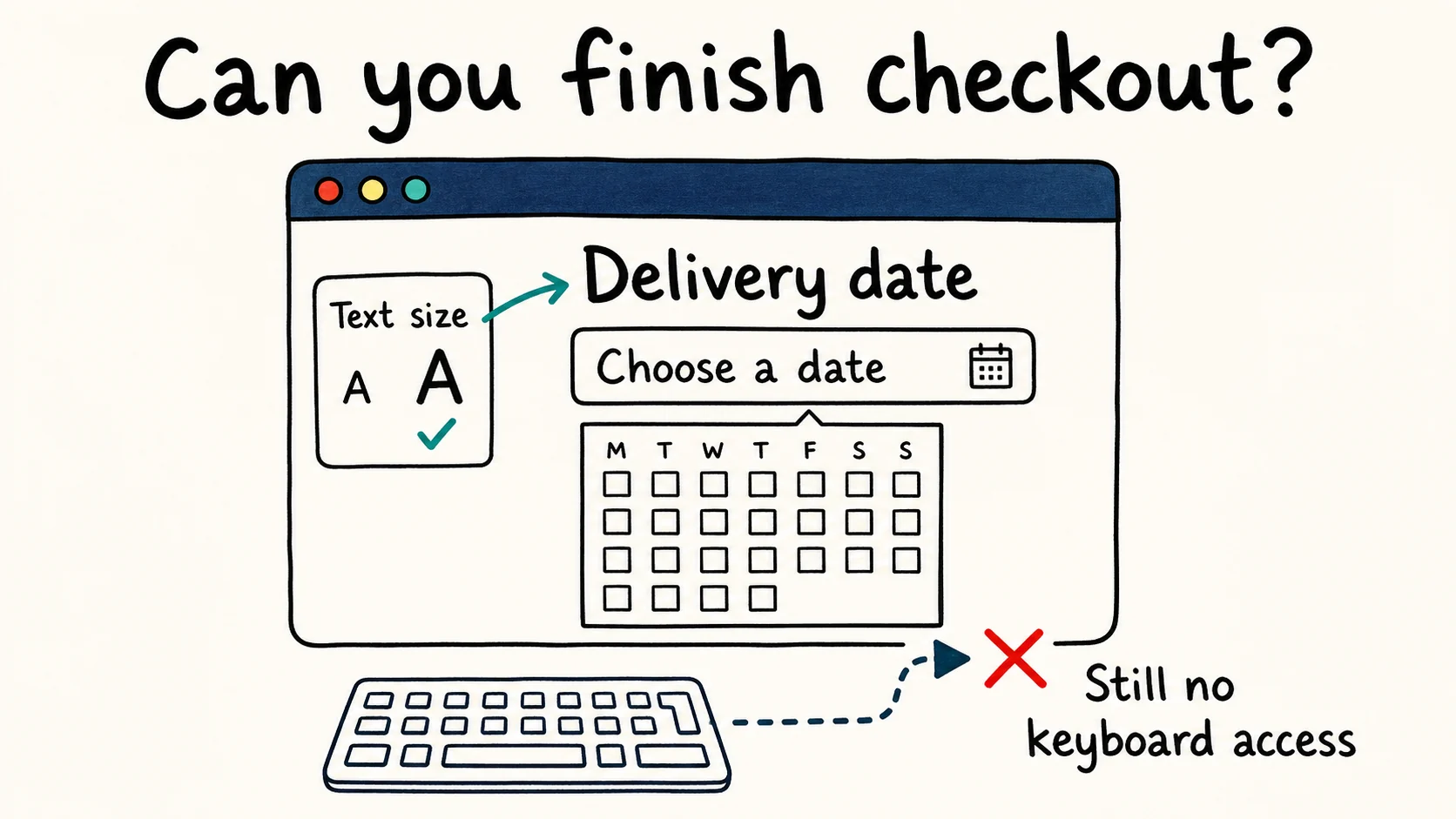
Start with one important customer journey, such as finding a product and completing checkout. Then work through four steps.
Write down the scope. Record the service, markets, applicable rules, target standards and responsible person. Include the pages, app screens, documents and external components customers need to finish the task.
Test the complete journey. Combine automated scans with keyboard and screen-reader checks. Include sign-in, validation errors, payment and confirmation. Check zoom and narrow layouts. W3C’s evaluation guidance explains why automated tools cannot determine accessibility on their own; involve people with disabilities to uncover barriers your team may miss.
Fix barriers in a useful order. Prioritise failures that stop someone completing the task, then shared components that repeat across the service. A working product page does little for a customer blocked by an inaccessible payment step. Include third-party widgets in testing and give suppliers specific failures to resolve.
Keep evidence and retest changes. Save the scope, test dates, methods, findings and verified fixes. Record untested areas honestly. Add repeatable checks to releases and review the journey when checkout providers, components or content change.
Annex I’s e-commerce requirements include accessible identification, security and payment functionality. Shops must also provide accessibility information about the products and services they sell when the responsible economic operator supplies that information.
What could Annex V accessibility information look like?
Article 13 and Annex V require accessible information explaining the service, its operation and how it meets relevant requirements, plus information about maintaining compliance. Include it in your general terms or an equivalent document, and make it publicly available in accessible written and oral formats.
For a fictional shop, an excerpt might read as follows. This is an illustration, not a complete compliance template; only make claims your testing supports.
- Our service: Customers browse products, add items to a basket, enter delivery details and pay online. We send an order confirmation by email.
- Using the checkout: Each field has a label. Errors identify the affected field and explain how to correct it. Customers can complete checkout using a keyboard.
- Keeping it accessible: We test changes to checkout before release and track reported barriers through to a verified fix.
Complete your own information with the applicable requirements, how the whole service meets them, and the checks supporting those claims. Make it easy to find and provide an accessible contact route. Keep fixing barriers in the service itself; an accessibility overlay cannot replace that work.
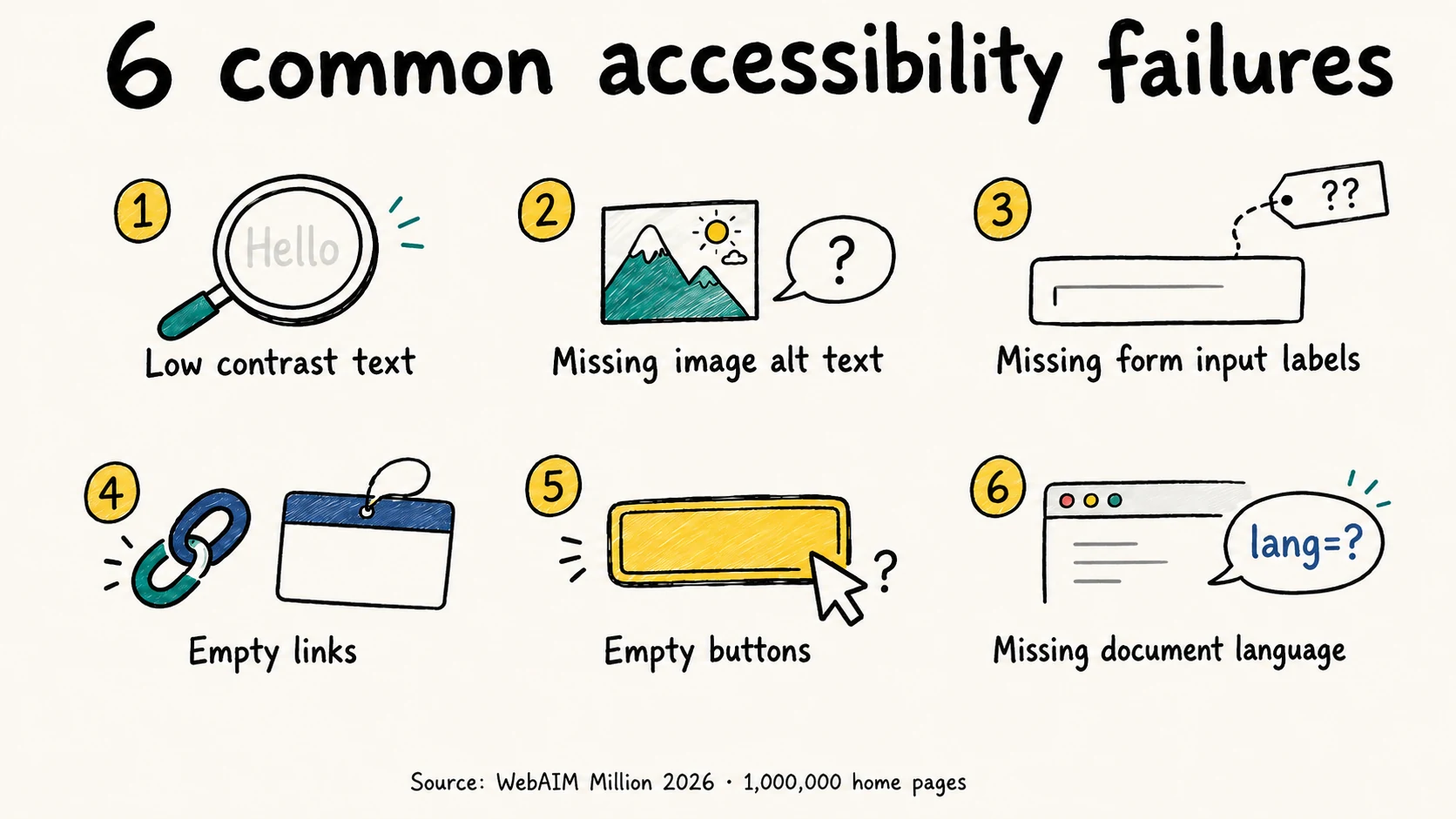
See which of these failures your own page has
One URL, one scan, and the exact element plus the rule it breaks — no signup needed for the first report.
Run a free scanAccessiLume cites primary standards and published research. Checked against EU legislation, W3C standards and public authority guidance.
- European Commission. European Accessibility Act (EAA). Covered products and services.
- European Parliament and Council. Directive (EU) 2019/882. Articles 2–4, 13–15, 30 and 32; Annexes I and V. EUR-Lex text.
- Competition and Consumer Protection Commission, Ireland. European Accessibility Act guidelines for microenterprises. Business guidance, including scope for suppliers based outside the EU.
- W3C Web Accessibility Initiative. WCAG 2 Overview. Versions, conformance levels and international standardisation.
- ETSI, CEN and CENELEC. EN 301 549 V4.1.1. September 2026. ICT requirements, Annex ZB and clause A.2 on the EAA.
- European Commission, AccessibleEU. The European accessibility standard EN 301 549 has been updated. 7 September 2026. WCAG 2.2 and pending Official Journal citation.
- W3C Web Accessibility Initiative. Web Accessibility Laws & Policies. Directory of national and regional requirements.
- W3C Web Accessibility Initiative. Evaluating Web Accessibility Overview. Automated checks, expert evaluation and user involvement.